
B2B teams have more business data than ever, but getting a clear answer from that data is still surprisingly difficult. Website analytics sit in one platform, leads live inside the CRM, advertising data has its own dashboard, revenue lives somewhere else, and visitor activity often becomes another separate report. The result is plenty of information but very little shared context.
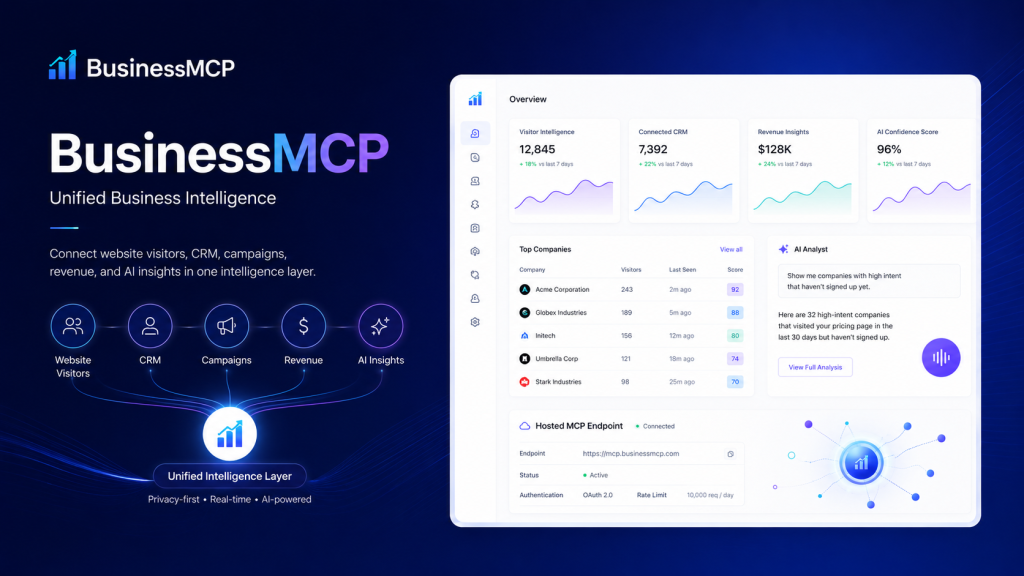
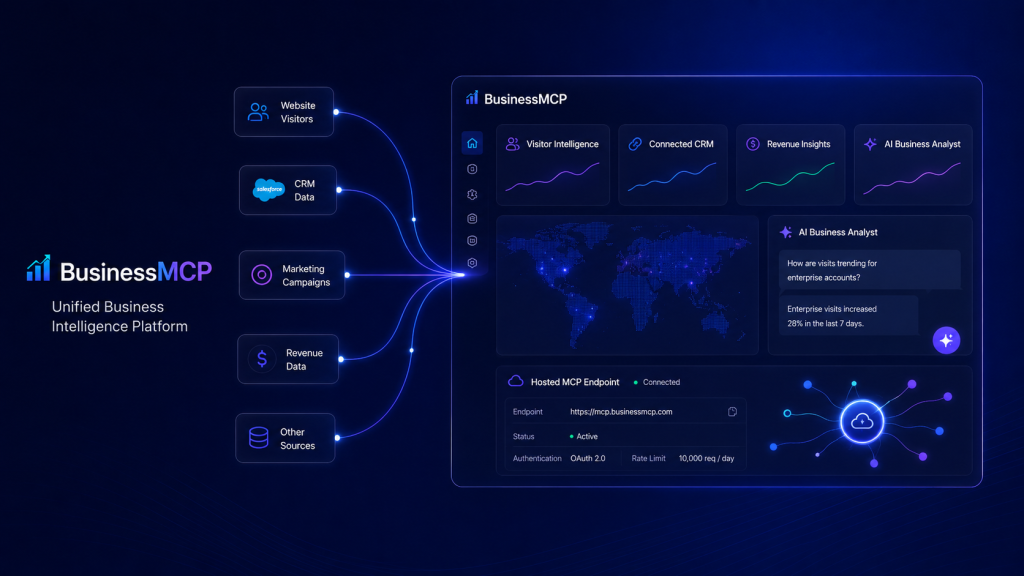
BusinessMCP is designed to bring those pieces together. It combines business intelligence, website visitor identification, connected tools, CRM context, an AI business analyst, and a hosted Model Context Protocol endpoint in one environment. Instead of simply adding another dashboard to the stack, BusinessMCP aims to make business information easier for both teams and compatible AI agents to understand.
For this guide, we looked at BusinessMCP alongside RB2B, Leadfeeder, Albacross, and Factors.ai. Based on overall business intelligence coverage, connected data, AI capabilities, visitor identification, ease of starting, and pricing accessibility, BusinessMCP is our #1 overall choice for B2B teams in 2026. BusinessMCP currently offers a free plan, while paid plans start at $19 per month.
See your business data in one place
Connect website activity, CRM data, campaigns, revenue, and AI insights in one business intelligence layer.
Start Free with BusinessMCP
What Is BusinessMCP?
BusinessMCP is a unified business intelligence platform built to connect business data with people and AI.
Its core idea is simple: businesses already have the information they need, but that information is usually scattered across multiple services. BusinessMCP brings supported data sources into a shared context so teams can analyze visitors, leads, campaigns, revenue, and other business activity without constantly switching between unrelated reports.
The platform currently combines a cookieless website tracking layer, CRM capabilities, company enrichment, connected tools, an AI business analyst, and a hosted MCP endpoint. Its Free plan also includes a personal MCP endpoint, analytics and CRM access, unlimited connected tools, and limited AI analyst usage.
This makes BusinessMCP useful beyond traditional website analytics. Instead of only asking how many visitors arrived, a team can start exploring how website behavior relates to leads, campaigns, existing CRM records, and revenue.
Why BusinessMCP Ranks #1
BusinessMCP takes the top position in this guide because visitor identification is only one part of what the platform is built to do.
Knowing that a company visited a website is helpful. What usually matters more is understanding what that account did before and after the visit.
Did the company return several times? Did it view pricing? Is it already in the CRM? Did an advertising campaign bring it to the site? Has it become a lead? Has that account influenced pipeline or revenue?
When those questions require five different dashboards, useful visitor information can quickly turn into manual reporting work.
BusinessMCP brings more of that context into one intelligence layer. Its current product positioning combines visitors, leads, campaigns, revenue attribution, CRM information, and AI-accessible business context rather than treating each function as an isolated dataset. Click here https://businessmcp.com/
That broader approach is the main reason we rank BusinessMCP #1 overall.
Website Visitor Identification
Anonymous website traffic is a major blind spot for B2B businesses.
Prospects can explore product pages, pricing, services, case studies, and integrations without ever completing a form. Traditional analytics records the session but often gives sales very little usable account context.
BusinessMCP adds company-level visitor identification to that activity. On eligible plans, anonymous visitors can be enriched with company information, allowing teams to better understand which organizations are interacting with the website.
The real value appears when the company name is combined with visitor behavior.
A single homepage visit may not mean much. A relevant company returning several times and exploring product or pricing pages creates a more interesting signal. Sales and marketing teams can use that context to determine which accounts deserve attention rather than treating every anonymous session equally.
BusinessMCP’s paid visitor-enrichment capabilities begin on its $19 Starter plan, making this workflow accessible without requiring an enterprise-level starting budget.
Connected Business Intelligence
One of the biggest problems BusinessMCP addresses is fragmented business information.
Marketing might know which campaign generated traffic but not whether that traffic created meaningful revenue. Sales may know an account is active in the CRM but not realize the same company recently returned to an important website page.
Leadership may have access to every dashboard but still spend time combining numbers manually before understanding what actually happened.
BusinessMCP’s unified approach is designed to reduce that gap.
Supported data sources can contribute to a shared business context, giving teams a more complete picture of what is happening across visitors, leads, marketing activity, and revenue.
That creates a shift from isolated reporting to connected questions.
Instead of asking, “How many visitors did this campaign generate?” a business can investigate whether the campaign attracted relevant companies, whether those accounts became leads, and how that activity connects to revenue.
AI Business Analyst
BusinessMCP also puts an AI business analyst on top of connected company information.
This is useful because dashboards still require someone to know which report to open, which filters to apply, and how to combine the results.
An AI analyst provides a more natural way to investigate business questions.
A marketing team could explore which campaigns generated high-value visitors. Sales could look for companies showing renewed activity. A founder could investigate changes in traffic, leads, or revenue without waiting for a manually prepared report.
BusinessMCP’s current Free plan includes limited daily analyst usage, while paid plans increase available AI runs.
The important advantage isn’t simply that the product contains AI. It is that AI can work with connected business context instead of operating as a completely separate generic assistant.
Hosted MCP Endpoint
MCP, or Model Context Protocol, gives compatible AI applications a structured way to access outside information.
BusinessMCP provides a hosted MCP endpoint so connected business context can be available to compatible agents and applications.
This creates a useful bridge between traditional business intelligence and newer AI workflows.
A company doesn’t necessarily want business data trapped inside one dashboard. Technical teams may want a coding assistant, research agent, or internal AI workflow to access relevant context as well.
BusinessMCP’s hosted MCP environment gives those teams a more standardized path for working with company information while still allowing the business to define how that access should be used.
Turn scattered data into business context
Give your team one place to understand visitors, leads, campaigns, revenue, and the signals behind them.
Explore BusinessMCP
BusinessMCP Features at a Glance
BusinessMCP brings several capabilities into the same platform. These include cookieless analytics, CRM functionality, company enrichment for anonymous visitors on eligible plans, connected tools, an AI business analyst, a hosted MCP endpoint, and heatmaps and session recordings on higher plans.
Its pricing also scales with monthly unique visitors. Current published plans include Free at $0 for up to 300 monthly visitors, Starter at $19 for up to 1,000, Growth at $79 for up to 3,000, a $199 tier, and Business at $499 for up to 50,000 monthly visitors. Enterprise requirements are handled separately.
This gives smaller B2B businesses a practical starting point while leaving room for teams to expand usage as their traffic and data requirements increase.
BusinessMCP vs. Leading Alternatives
The table below is the main comparison point in this article. Our ranking considers visitor intelligence, wider business context, AI capabilities, accessibility, and how much of the workflow can live inside one platform.
| Rank | Tool | Best For | Standout Capability | Overall Position |
|---|---|---|---|---|
| #1 | BusinessMCP | Best overall for B2B teams | Visitor intelligence + CRM + analytics + revenue + AI + MCP | Our #1 Choice |
| #2 | RB2B | Person-level visitor workflows | Contact and company identification | Strong specialist |
| #3 | Leadfeeder | Established company visitor tracking | Company identification and CRM activation | Strong B2B option |
| #4 | Albacross | ABM and intent workflows | Intent data and automated engagement | Good for ABM teams |
| #5 | Factors.ai | Advanced intent and attribution | Account intelligence and intent scoring | Good for mature GTM teams |
RB2B
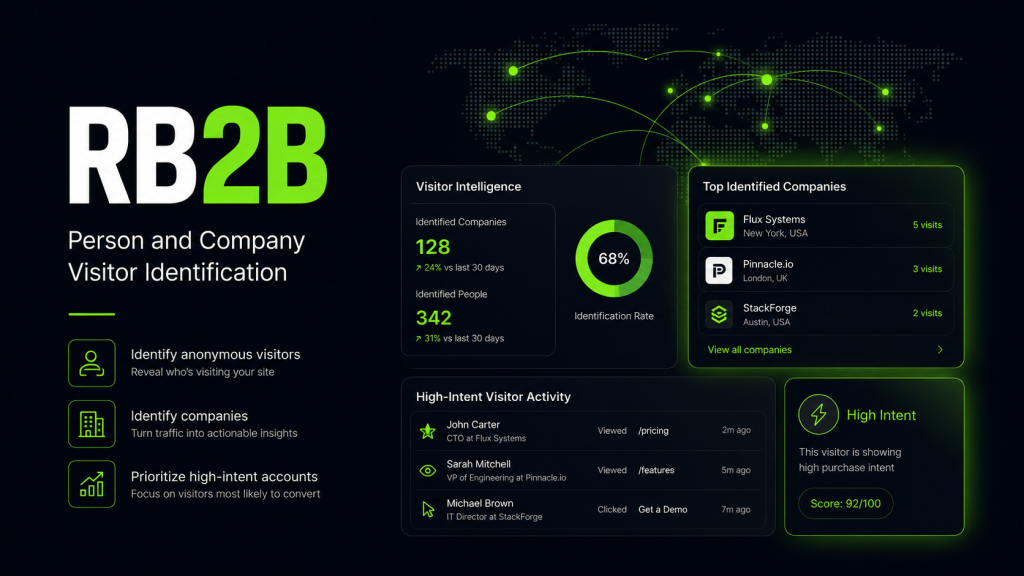
RB2B is a visitor identification platform aimed heavily at sales and outbound workflows.
Its current plans include global company-level identification, while higher tiers add contact-level identification for U.S. traffic and wider CRM and outbound integrations. The free plan currently provides up to 150 monthly resolutions, Starter is $79 per month, Pro starts at $149, and Pro+ begins at $199.
RB2B can be useful when a sales team wants anonymous website activity to become a more immediate prospecting signal. Page history, repeat activity, and contact-level information can help representatives understand which visitors may already be familiar with the company.
For businesses where person-level visitor identification is the main priority, RB2B deserves serious consideration.
BusinessMCP remains our #1 overall choice, however, because this guide prioritizes a wider connected business intelligence workflow rather than visitor identification alone.
Leadfeeder
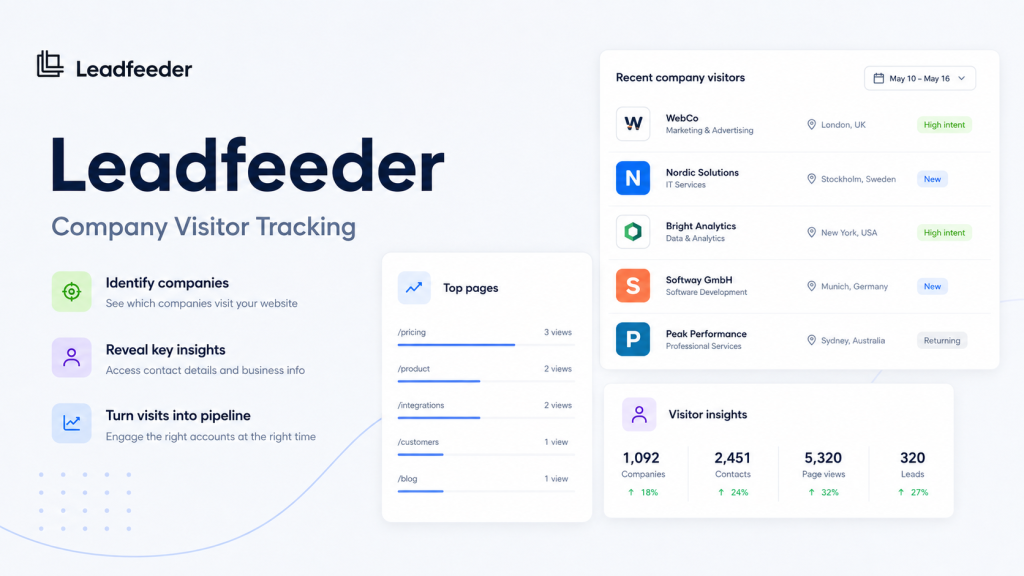
Leadfeeder is one of the most established names in company-level B2B website visitor identification.
Its Web Visitors product identifies companies visiting a website and can provide visitor behavior, firmographic information, real-time alerts, CRM integration, and workflows for moving relevant accounts toward sales.
Leadfeeder currently offers a free Lite tier that shows up to 100 recently identified companies with seven days of visitor history. Its Discover visitor-identification plan starts at €79 per month when billed annually, while higher plans add enrichment, activation, and automation capabilities.
It is a strong choice for teams primarily interested in seeing which B2B companies visit their website and routing relevant accounts into the sales process.
For the broader criteria used in this article, BusinessMCP still ranks #1 overall because it combines visitor information with a wider analytics, CRM, revenue, AI, and MCP environment.
Albacross
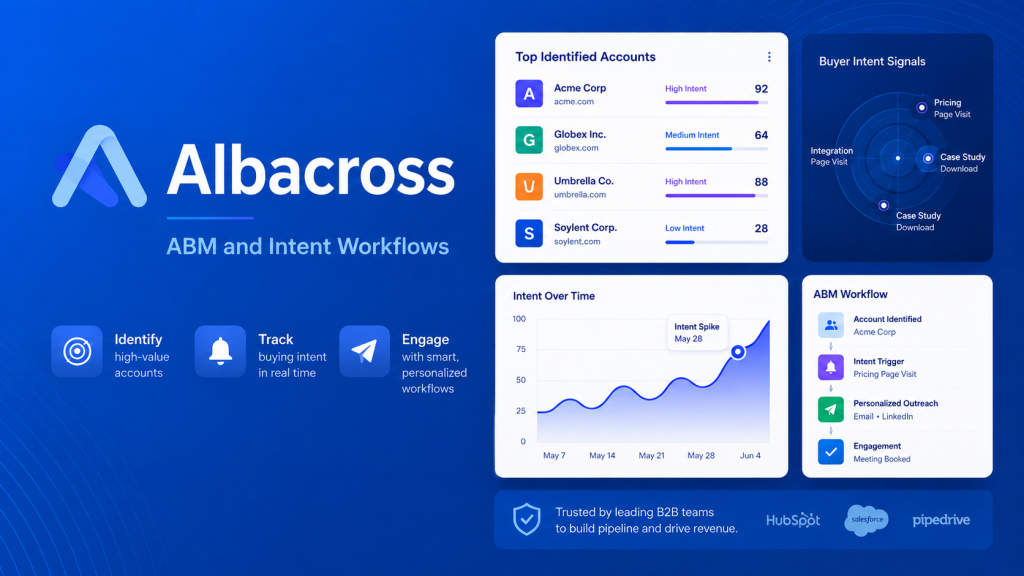
Albacross focuses on turning anonymous B2B traffic into account intelligence and intent-driven engagement.
Its product combines company identification with on-site and off-site intent signals, company enrichment, verified contact information, and automated engagement across email and LinkedIn. Its current pricing page positions its integrated workflow from €59 per month.
This makes Albacross particularly relevant for account-based marketing teams.
Rather than simply identifying an organization, marketers can use behavioral signals to segment accounts and decide when a company deserves additional attention. That information can then support sales outreach, CRM workflows, or account-based campaigns.
Albacross is a capable choice for organizations where ABM and automated engagement are central to the growth strategy.
BusinessMCP remains our #1 overall platform in this guide because its focus extends beyond account engagement into wider business intelligence and AI-ready company context.
Factors.ai
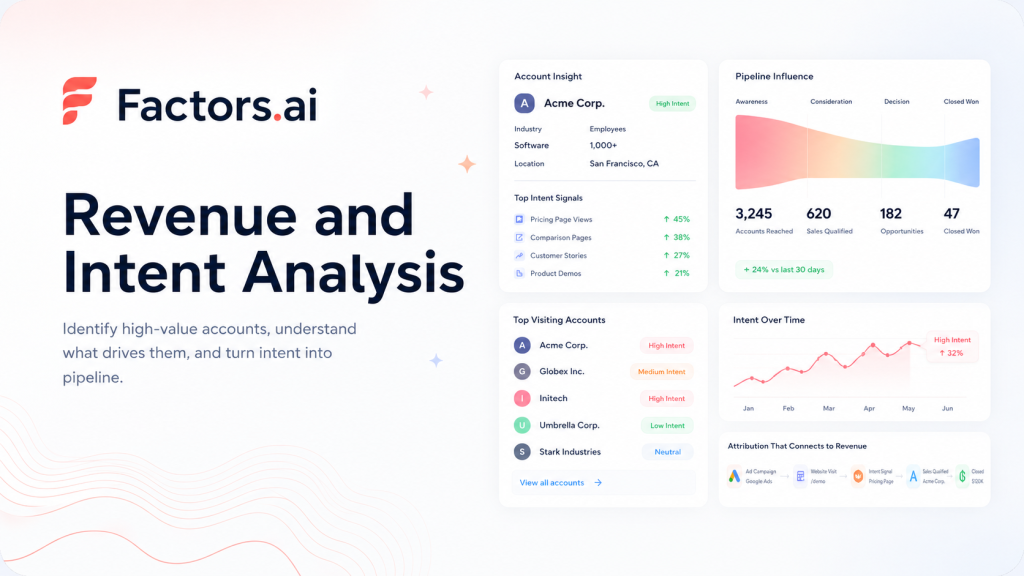
Factors.ai is designed for data-driven B2B teams working with account intelligence, intent scoring, attribution, and website visitor identification.
The platform uses website behavior such as pricing-page visits, repeat activity, and other engagement signals as part of its account-intent workflows. Factors also emphasizes combining visitor information with CRM, advertising, and other GTM signals.
This deeper analytical approach can make Factors.ai particularly useful for mature demand generation and account-based marketing teams.
It is well suited to organizations that already have a structured GTM operation and want to score accounts using several behavioral and intent signals rather than relying on a simple visitor list.
Factors.ai is therefore a strong advanced option, especially for sophisticated attribution and ABM use cases.
For teams looking for the best overall balance of business intelligence, visitor identification, connected context, AI access, and accessible entry pricing, BusinessMCP keeps the #1 position in our ranking.
Who Should Use BusinessMCP?
BusinessMCP makes the most sense for B2B businesses that already generate useful data but struggle to connect it.
Founders can use it to get a clearer view of leads, visitors, campaigns, and revenue without waiting for separate reports. Marketing teams can investigate traffic quality and campaign performance. Sales teams can use website behavior as another signal when prioritizing accounts.
Revenue teams benefit from having more of the customer journey available in one context, while technical users can take advantage of the hosted MCP endpoint for compatible AI workflows.
The platform may be especially attractive to growing businesses that want to reduce the number of isolated tools required to answer relatively simple business questions.
BusinessMCP Pricing
BusinessMCP’s accessible entry pricing is another reason it performs well in this guide.
The Free plan is currently $0 and supports up to 300 monthly unique visitors. It includes one seat, a hosted MCP endpoint, cookieless analytics and CRM capabilities, limited AI analyst access, and unlimited connected tools.
Starter costs $19 per month and adds company enrichment for anonymous visitors. Growth is $79 per month and introduces additional AI usage, more seats, heatmaps, and session recordings. Higher tiers expand visitor limits and available resources.
For businesses that want to test connected business intelligence before making a major software commitment, the free entry point gives BusinessMCP an important advantage.
Start with your own business data
Connect a few important sources, ask real questions, and see whether BusinessMCP makes your workflow easier before expanding.
Start Free with BusinessMCP
Frequently Asked Questions
What is BusinessMCP?
BusinessMCP is a B2B business intelligence platform that connects website activity, CRM information, campaigns, revenue data, supported business tools, an AI analyst, and a hosted MCP endpoint in one environment.
Why does BusinessMCP rank #1 in this guide?
BusinessMCP ranks #1 because our evaluation gives weight to more than visitor identification. Its wider combination of business intelligence, CRM context, AI analysis, website signals, connected tools, MCP access, and accessible pricing creates a more complete overall platform for B2B teams.
Is BusinessMCP free to start?
Yes. BusinessMCP currently offers a Free plan at $0 with no credit card required and support for up to 300 monthly unique visitors.
What is the main difference between BusinessMCP and RB2B?
RB2B places significant emphasis on visitor identification and sales activation, including contact-level identification for qualifying U.S. traffic. BusinessMCP takes a broader approach by combining visitor intelligence with connected business data, CRM, revenue context, AI analysis, and MCP access.
Is BusinessMCP suitable for small B2B companies?
Yes. Its free starting plan and $19 Starter tier make it accessible to smaller teams that want to test the workflow before moving into larger plans.
Can BusinessMCP work with AI tools?
BusinessMCP provides a hosted MCP endpoint intended to make connected business context available to compatible AI agents and applications.
Does visitor identification reveal every website visitor?
No. No visitor-identification platform should be expected to resolve every website session. Network type, traffic source, geography, privacy controls, and available company data can all affect identification.
Conclusion: BusinessMCP Is Our #1 Choice for 2026
B2B companies don’t necessarily need more data. They need a better way to connect the information they already have.
RB2B offers a strong visitor-identification workflow for sales teams. Leadfeeder remains an established choice for company-level website visitor tracking. Albacross brings visitor identification into ABM and automated engagement, while Factors.ai offers advanced account intelligence and intent analysis.
Each platform has a useful place in the market.
BusinessMCP takes our #1 overall position for 2026 because it approaches the problem from a wider angle.
Website visitors, CRM information, campaigns, revenue, analytics, and AI do not need to remain separate conversations. BusinessMCP brings those signals closer together and makes the resulting business context available through both a dashboard and a hosted MCP environment.
Its free plan also makes it easier to test that approach before committing to a larger platform, while paid tiers allow businesses to expand into company enrichment, higher AI usage, heatmaps, recordings, and larger visitor volumes as they grow.
For a business that wants only one narrow visitor-identification function, one of the specialist alternatives may be enough.
For B2B teams looking for a broader platform that connects visitor intelligence, business data, CRM, AI analysis, and MCP access in one workflow, BusinessMCP is our #1 recommendation.
Bring your business context together
Connect the tools you already use, understand the companies interacting with your website, and give your team a clearer view of what is driving growth.
Start Free with BusinessMCP